


.JPG)





.JPG)
The Boghe regional house is decorated like a winter wonderland in an attempt to bring the Christmas spirit to Islamic West Africa. Handmade stockings are hung by the mosquito net with care, paper snowflakes hang from the ceiling, red and green garland is draped along the walls and a miniature Christmas tree sits upon a small pile of gifts. Each volunteer in the region created small gifts to put in the stockings and last night we dressed as festively as possible and gathered around the tree to look in our stockings while toasting the season with cheap gin and a few rounds of flip-cup. It seems I have travelled a long way from jingle juice and the family festivities of last year…
December 1 was World AIDS day so in celebration a local NGO, World Vision, sponsored a panel discussion in my village on Wednesday, December 3. I arrived at the local preschool with Hawa and the two nurses and was surprised to learn that I was expected to present a sensibilization in Pulaar although I had not been informed of this ahead of time; therefore, I politely declined and explained that I had not prepared and took a seat on the side of the stage. Instead, I took the opportunity to take a bunch of pictures as I watched local school children present a play about AIDS in both Pulaar and then Hassaniya and then listened to both Diallo (head male nurse) and Binta present on various aspects of HIV/AIDS. Although I did not fully understand the presentations I was pleased that everyone seemed interested in the topic and was extremely happy about the large turnout.
Afterwards I was invited with the other participants to eat Banafe – a delicious meat and potato dish – at the local World Vision Director’s house. As I was waiting for dinner to finish cooking I was talking to the Regional Director for World Vision, a man that I had met about a month before at the Silbe sensibilizations, and he mentioned that he had a gift for me and headed towards his car. When he returned he handed me an internet printout with my picture and an article about the EMS scholarship that I was awarded last fall and said “I think this is you” and we proceeded to have a conversation about my scholarship but the entire experience was extremely surprising and further reminded me of all that is possible with access to the internet.
The weather has gotten progressively colder and bathing is becoming more and more complicated. Most nights and mornings I am wrapped up in pants, skirt, and multiple shirts and a sweatshirt in addition to a blanket or two and several days I have remained inside due to the ‘frigid’ weather; however, I would imagine the temperature has not dropped below 50 degrees. The Mauritanians are often decked out in wool hats and heavy, snow jackets over their traditional clothing which is an interesting sight.
Attended the naming ceremony of a host cousin and watched all day as the women cooked for a hundred plus guests in three huge iron pots. Although I doubt I will ever be able to cook as well as the African women over an open fire, I am learning the skill and hope to attempt African-style cooking at some point in the future. The ceremony itself includes the slaughtering of a male goat which is then cooked for the evening male although the heart is cooked directly on the coals and eaten by the village elders in a slightly ceremonial style.
Tabaski, the Islamic celebration of meat and animal slaughtering, was December 8. I went to bed early the night before when I was suddenly hit with a wave of nausea. Throughout the evening I got progressively worse much to the concern of my host family whose response to my illness was to call the local nurse who would encourage me to take a variety of unnecessary medications, including amoxicillin, although I continually repeated that I did not need an antibiotic and really wanted to be left alone to sleep (and not attempt to think or talk in a language other than English).
By the next morning I was still feeling lousy and my host family almost brought me to tears with frustration since they refused to leave me alone to sleep or deal with my illness alone. Within hours of waking up, my host mother had left the children to prepare the celebratory meal and was sitting on the floor of my room watching me rest and asking me every several minutes how I was feeling and forcing me to eat coffee and bread no matter how many times I told them I was not hungry.
Throughout the afternoon I began feeling slightly better and by 2 I had joined the family outside for the first round of meat and to greet a number of visitors. Within the hour 7 other meat dishes had been delivered to our household plus the saffron couscous and meat dish that my family had prepared for the occasion. For lunch we ate half of the dishes, reserving the other ones for dinner, and followed the feast with the traditional three rounds of mint tea.
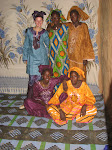
An hour before sunset I dressed in my new African clothes, donned pearls and make-up and embarked into the village with Hawa and Aissata (host sister) to visit a number of houses within the village. At half a dozen compounds we were invited inside to eat more meat and potatoes. Much of the night reminded me of Halloween night minus the Power Ranger costumes and candy, since we moved from house to house in bright colored outfits and was often passed by large groups of loud children. Eventually returned home to drink more mint tea and eat 2 more meat dishes.
The next night I was called into the health post to aid with a delivery. After a particularly prolonged labor with little advancement of the baby, the mother was eventually given a shot of oxytoxin to further induce labor and within minutes the baby crowned. The baby was blue upon delivery and failed to cry within a reasonable amount of time so it was wrapped in a cloth and slapped, flicked, tapped and rubbed in an attempt to encourage breathing. After 30 minutes the baby’s color had improved slightly with a few breaths but the baby had still not succeeded in a deep wail and its breathing pattern reminded me of a baby lamb.
I left the health post discouraged and concerned that the baby would not survive through the night likely because of causes easily resolved within the developed world. In my opinion the baby would have likely improved with a little oxygen but in the middle of the African desert I was once again forced to recognize the limited resources available to many people within Mauritania and likely most of West Africa. This experience further reinforced my desire to continue my studies in medicine and to return at some point to provide medical aid to the underprivileged people of developing nations, but a few minutes after 1am I was exhausted and forced to grief in private as many African women are accustomed to the possibility of a child’s premature death.
Midday on the 10th of December I heard the beat of drums begin near the river and watched as many of the local children ran in the direction of the sound. The drumming began again later in the afternoon but was located to the north of the village and this time women and men joined the mass movement of children towards the sound. Gathered in a cleared area of desert on the northern outskirts of town, a group of villagers were gathered around 5 musicians keeping beat with a variety of African drums. Throughout the 2.5 hour performance, various women from the village stepped into the circle where they danced to the beat for several minutes while other women took turns stepping forward to hand them money and place headscarves around the dancing women’s necks. In seemed to me that the money and scarf donating were done as a sign of enjoyment since some women received more gifts than others and often the better dancers were lavishly decorated by the time they returned to their place in the circle.
The drumming began again at the same time the next day and flocks of villagers once again moved to the desert clearing; however, I chose to remain behind and hold a personal dance party in my room while all other host family members were gone.
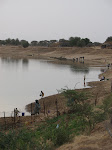
A week ago, I traveled with my host family and several other villagers to a neighboring village for a small fete. After a 30 min ride west on horse carts, we arrived at a waiting canoe that transported us to the opposite bank where we then walked a kilometer or two as the sun began to set. Upon arrival everyone dressed in bright, colorful garments and the girls put on thick makeup before following the sounds of drums to a generator-lit, rice sack enclosed area loud with the sounds of talking and laughing. As I entered the ‘arena’ I was taken aback by the large number of teenagers gathered in such a small area but I progressed forward with my party and took a seat on a plastic mat on the outskirts of the enclosed area. In the empty center of the area, a dozen of scantily clad men were stretching and jumping as if in preparation for an athletic event. The competitors wore speedo-ish costumes with sewed fabric ‘tails’ or ruffled extensions on their buttocks that shook as they moved in addition to knee-high soccer socks. After what seemed like hours, the center ring cleared and two men emerged to the cheer of the crowd and the fast beat of drums – and began to wrestle. Although I am unsure of all the rules to this African version of wrestling I am pretty sure that during the 4 rounds points are awarded for successfully touching or removing your opponents ‘ruffled tail’ in addition to throwing your opponent to the ground. After about 6 minutes one man was declared the winner and then the enclosed area began to clear slightly.
During the next three hours, different groups of people gathered around the drums and collected money in honor of a woman in what appeared to be a fundraiser. Each girl’s name was called over the speaker initially and then as money was collected the name of each donator and the amount was also announced to the general public. At the end, the total amount collected was announced but I am unsure whether the money went to a specific cause or was given to the chosen girls. This continued for approximately 30 girls – 2 of which I followed my group to the drum area to aid with the collection. Most people gave coins, or between 100 to 200 ouguiya and the end results were around 3 or 4 thousand um (12-16 dollars). Although I do not understand much of the event, it was surrounded by the feeling of celebration and I was happy to participate even if I was overwhelmed and confused at many points throughout the evening.
Around midnight I followed my family to a local house where we found some mat and blankets and created a place to sleep on the floor of their foyer. At daybreak, I awoke to the smell of wood burning as the cooking fires had been lit directly outside the foyer. After a brief breakfast of coffee and camel biscuits – small oyster like crackers – we rejoined the group from OloOlogo on the river bank to return home. We had to wait 40 minutes for someone on the other riverbank to arrive and row the canoe across and then I waited for three other trips to cross the river. While waiting for the canoe to return to my bank the second time, a horse cart arrived and prepared to cross. I was confused but extremely intrigued as the horse was removed from the cart and then the cart was pushed onto the front of the canoe, balancing quite precariously. Once a few people also got in the canoe, I chose to take the next one as I was worried the boat was soon to tip, it set off across the fast flowing river with the horse swimming beside the boat. Luckily, it made it to the other bank without incident and returned in a timely manner so I could wade through the currently chilly water and squat in the bottom of the hollow tree canoe for 10 minutes while attempting to keep my body centered so as not to rock the boat. Several times water splashed over the edge due to high winds but we successfully returned to the shore and once again boarded horse carts for the desert journey home.
Construction on my room has finally begun. I returned to site a few weeks ago to find the walls 11 bricks high which is a welcome progression from the piles of bricks and dirt that I left at Thanksgiving. I talked to my host father briefly and he said that the walls had taken 2 days and should be fully completed within another 2 or 3 days. Also, while I was in OloOlogo a man from Senegal arrived to take measurements to order the roofing supplies so I am optimistic that upon my return in January I can finally move into a personal room with a locking door! The room itself is approximately 2.5 x 4.5 meters with a small storage space to keep all my baggage and two windows with bars. Before I return I plan to invest in a bigger plastic mat and some fabric to create drapes for my windows and door.
Leave early tomorrow morning to travel to Nouakchott for Christmas Eve and Christmas Day and then plan on traveling to St. Louis, Senegal with many of the other volunteers to celebrate New Years in style. Although I continue to have new experiences in West Africa, I miss home terribly and wish that I could be spending the holidays with my family and friends, participating in traditional activities and reconnecting with people I talked with infrequently over the last year. So to everyone that I am missing and will not see this holiday season, Merry Christmas and Happy New Year – Best Wishes for 2009!

2 comments:
i love the picture of the tabaski! some of your adventures sound suspiciously similar to scenes from oregon trail. as always, miss you, love you, and happy 2009!!
hello
nice blog, awesome pictures...congratulations
regards
natacha
www.jvnonline.com
www.jvnonline.blogspot.com
Post a Comment