Tuesday, December 23, 2008

I’ll be Home for Christmas, If Only in my Dreams

The Boghe regional house is decorated like a winter wonderland in an attempt to bring the Christmas spirit to Islamic West Africa. Handmade stockings are hung by the mosquito net with care, paper snowflakes hang from the ceiling, red and green garland is draped along the walls and a miniature Christmas tree sits upon a small pile of gifts. Each volunteer in the region created small gifts to put in the stockings and last night we dressed as festively as possible and gathered around the tree to look in our stockings while toasting the season with cheap gin and a few rounds of flip-cup. It seems I have travelled a long way from jingle juice and the family festivities of last year…

December 1 was World AIDS day so in celebration a local NGO, World Vision, sponsored a panel discussion in my village on Wednesday, December 3. I arrived at the local preschool with Hawa and the two nurses and was surprised to learn that I was expected to present a sensibilization in Pulaar although I had not been informed of this ahead of time; therefore, I politely declined and explained that I had not prepared and took a seat on the side of the stage. Instead, I took the opportunity to take a bunch of pictures as I watched local school children present a play about AIDS in both Pulaar and then Hassaniya and then listened to both Diallo (head male nurse) and Binta present on various aspects of HIV/AIDS. Although I did not fully understand the presentations I was pleased that everyone seemed interested in the topic and was extremely happy about the large turnout.

Afterwards I was invited with the other participants to eat Banafe – a delicious meat and potato dish – at the local World Vision Director’s house. As I was waiting for dinner to finish cooking I was talking to the Regional Director for World Vision, a man that I had met about a month before at the Silbe sensibilizations, and he mentioned that he had a gift for me and headed towards his car. When he returned he handed me an internet printout with my picture and an article about the EMS scholarship that I was awarded last fall and said “I think this is you” and we proceeded to have a conversation about my scholarship but the entire experience was extremely surprising and further reminded me of all that is possible with access to the internet.

The weather has gotten progressively colder and bathing is becoming more and more complicated. Most nights and mornings I am wrapped up in pants, skirt, and multiple shirts and a sweatshirt in addition to a blanket or two and several days I have remained inside due to the ‘frigid’ weather; however, I would imagine the temperature has not dropped below 50 degrees. The Mauritanians are often decked out in wool hats and heavy, snow jackets over their traditional clothing which is an interesting sight.

Attended the naming ceremony of a host cousin and watched all day as the women cooked for a hundred plus guests in three huge iron pots. Although I doubt I will ever be able to cook as well as the African women over an open fire, I am learning the skill and hope to attempt African-style cooking at some point in the future. The ceremony itself includes the slaughtering of a male goat which is then cooked for the evening male although the heart is cooked directly on the coals and eaten by the village elders in a slightly ceremonial style.

Tabaski, the Islamic celebration of meat and animal slaughtering, was December 8. I went to bed early the night before when I was suddenly hit with a wave of nausea. Throughout the evening I got progressively worse much to the concern of my host family whose response to my illness was to call the local nurse who would encourage me to take a variety of unnecessary medications, including amoxicillin, although I continually repeated that I did not need an antibiotic and really wanted to be left alone to sleep (and not attempt to think or talk in a language other than English).

By the next morning I was still feeling lousy and my host family almost brought me to tears with frustration since they refused to leave me alone to sleep or deal with my illness alone. Within hours of waking up, my host mother had left the children to prepare the celebratory meal and was sitting on the floor of my room watching me rest and asking me every several minutes how I was feeling and forcing me to eat coffee and bread no matter how many times I told them I was not hungry.

Throughout the afternoon I began feeling slightly better and by 2 I had joined the family outside for the first round of meat and to greet a number of visitors. Within the hour 7 other meat dishes had been delivered to our household plus the saffron couscous and meat dish that my family had prepared for the occasion. For lunch we ate half of the dishes, reserving the other ones for dinner, and followed the feast with the traditional three rounds of mint tea.

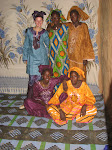
An hour before sunset I dressed in my new African clothes, donned pearls and make-up and embarked into the village with Hawa and Aissata (host sister) to visit a number of houses within the village. At half a dozen compounds we were invited inside to eat more meat and potatoes. Much of the night reminded me of Halloween night minus the Power Ranger costumes and candy, since we moved from house to house in bright colored outfits and was often passed by large groups of loud children. Eventually returned home to drink more mint tea and eat 2 more meat dishes.

The next night I was called into the health post to aid with a delivery. After a particularly prolonged labor with little advancement of the baby, the mother was eventually given a shot of oxytoxin to further induce labor and within minutes the baby crowned. The baby was blue upon delivery and failed to cry within a reasonable amount of time so it was wrapped in a cloth and slapped, flicked, tapped and rubbed in an attempt to encourage breathing. After 30 minutes the baby’s color had improved slightly with a few breaths but the baby had still not succeeded in a deep wail and its breathing pattern reminded me of a baby lamb.

I left the health post discouraged and concerned that the baby would not survive through the night likely because of causes easily resolved within the developed world. In my opinion the baby would have likely improved with a little oxygen but in the middle of the African desert I was once again forced to recognize the limited resources available to many people within Mauritania and likely most of West Africa. This experience further reinforced my desire to continue my studies in medicine and to return at some point to provide medical aid to the underprivileged people of developing nations, but a few minutes after 1am I was exhausted and forced to grief in private as many African women are accustomed to the possibility of a child’s premature death.

Midday on the 10th of December I heard the beat of drums begin near the river and watched as many of the local children ran in the direction of the sound. The drumming began again later in the afternoon but was located to the north of the village and this time women and men joined the mass movement of children towards the sound. Gathered in a cleared area of desert on the northern outskirts of town, a group of villagers were gathered around 5 musicians keeping beat with a variety of African drums. Throughout the 2.5 hour performance, various women from the village stepped into the circle where they danced to the beat for several minutes while other women took turns stepping forward to hand them money and place headscarves around the dancing women’s necks. In seemed to me that the money and scarf donating were done as a sign of enjoyment since some women received more gifts than others and often the better dancers were lavishly decorated by the time they returned to their place in the circle.

The drumming began again at the same time the next day and flocks of villagers once again moved to the desert clearing; however, I chose to remain behind and hold a personal dance party in my room while all other host family members were gone.

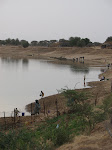
A week ago, I traveled with my host family and several other villagers to a neighboring village for a small fete. After a 30 min ride west on horse carts, we arrived at a waiting canoe that transported us to the opposite bank where we then walked a kilometer or two as the sun began to set. Upon arrival everyone dressed in bright, colorful garments and the girls put on thick makeup before following the sounds of drums to a generator-lit, rice sack enclosed area loud with the sounds of talking and laughing. As I entered the ‘arena’ I was taken aback by the large number of teenagers gathered in such a small area but I progressed forward with my party and took a seat on a plastic mat on the outskirts of the enclosed area. In the empty center of the area, a dozen of scantily clad men were stretching and jumping as if in preparation for an athletic event. The competitors wore speedo-ish costumes with sewed fabric ‘tails’ or ruffled extensions on their buttocks that shook as they moved in addition to knee-high soccer socks. After what seemed like hours, the center ring cleared and two men emerged to the cheer of the crowd and the fast beat of drums – and began to wrestle. Although I am unsure of all the rules to this African version of wrestling I am pretty sure that during the 4 rounds points are awarded for successfully touching or removing your opponents ‘ruffled tail’ in addition to throwing your opponent to the ground. After about 6 minutes one man was declared the winner and then the enclosed area began to clear slightly.

During the next three hours, different groups of people gathered around the drums and collected money in honor of a woman in what appeared to be a fundraiser. Each girl’s name was called over the speaker initially and then as money was collected the name of each donator and the amount was also announced to the general public. At the end, the total amount collected was announced but I am unsure whether the money went to a specific cause or was given to the chosen girls. This continued for approximately 30 girls – 2 of which I followed my group to the drum area to aid with the collection. Most people gave coins, or between 100 to 200 ouguiya and the end results were around 3 or 4 thousand um (12-16 dollars). Although I do not understand much of the event, it was surrounded by the feeling of celebration and I was happy to participate even if I was overwhelmed and confused at many points throughout the evening.

Around midnight I followed my family to a local house where we found some mat and blankets and created a place to sleep on the floor of their foyer. At daybreak, I awoke to the smell of wood burning as the cooking fires had been lit directly outside the foyer. After a brief breakfast of coffee and camel biscuits – small oyster like crackers – we rejoined the group from OloOlogo on the river bank to return home. We had to wait 40 minutes for someone on the other riverbank to arrive and row the canoe across and then I waited for three other trips to cross the river. While waiting for the canoe to return to my bank the second time, a horse cart arrived and prepared to cross. I was confused but extremely intrigued as the horse was removed from the cart and then the cart was pushed onto the front of the canoe, balancing quite precariously. Once a few people also got in the canoe, I chose to take the next one as I was worried the boat was soon to tip, it set off across the fast flowing river with the horse swimming beside the boat. Luckily, it made it to the other bank without incident and returned in a timely manner so I could wade through the currently chilly water and squat in the bottom of the hollow tree canoe for 10 minutes while attempting to keep my body centered so as not to rock the boat. Several times water splashed over the edge due to high winds but we successfully returned to the shore and once again boarded horse carts for the desert journey home.

Construction on my room has finally begun. I returned to site a few weeks ago to find the walls 11 bricks high which is a welcome progression from the piles of bricks and dirt that I left at Thanksgiving. I talked to my host father briefly and he said that the walls had taken 2 days and should be fully completed within another 2 or 3 days. Also, while I was in OloOlogo a man from Senegal arrived to take measurements to order the roofing supplies so I am optimistic that upon my return in January I can finally move into a personal room with a locking door! The room itself is approximately 2.5 x 4.5 meters with a small storage space to keep all my baggage and two windows with bars. Before I return I plan to invest in a bigger plastic mat and some fabric to create drapes for my windows and door.

Leave early tomorrow morning to travel to Nouakchott for Christmas Eve and Christmas Day and then plan on traveling to St. Louis, Senegal with many of the other volunteers to celebrate New Years in style. Although I continue to have new experiences in West Africa, I miss home terribly and wish that I could be spending the holidays with my family and friends, participating in traditional activities and reconnecting with people I talked with infrequently over the last year. So to everyone that I am missing and will not see this holiday season, Merry Christmas and Happy New Year – Best Wishes for 2009!

Sunday, November 30, 2008

Puppies and Basketball

The first Saturday after Thanksgiving, I helped Teresa with a girl’s basketball camp. In conjunction with her Girl’s Mentoring Center (GMC) she started a weekly basketball camp during which she will continue her girl’s empowerment lessons to the court by building confidence, increasing individuality and health awareness while allowing local girls to have a new experience. It was fantastic with many girls arriving dressed by local standards in extremely conservative clothing and many changing within minutes to shorts and tank-tops. In particular, we were extremely pleased to see one girl who arrived last week in a mulafa – traditional white moor dress that involves 6 meters of fabric which covers the women from head to toe – quickly change into a matching pant and shirt set. But the most rewarding part was watching the girls faces brighten as they chucked the ball towards the net, obviously having the time of their lives. One example of the affect sports can have on improving a societal group’s personal outlook on themselves and the world.
December 1 is World AIDS Day so on Sunday I helped Tiffany, another PC health volunteer, with a short presentation at the GMC about this important topic. I was pleased to see how well informed many of the girls (who likely ranged between the ages of 15-18) were regarding this often misunderstood disease that is often not talked about because of its close relation to the culturally taboo conversation topic of sex. I was also impressed by the girls willingness to speak openly about the disease and answers questions relating to its transmission and prevention. Overall, the entire presentation was fascinating to me since it was one of my first encounters with the topic of AIDS while serving in Africa. Tomorrow I have been invited with several other volunteers to attend a sensibilization in the marketplace presented by a local NGO in conjunction with the official day of recognition and discussion.
Within half an hour after returning to the regional house from the GMC I was talking to my parents on the phone when I suddenly heard “Tiffany, come here quick, some kids are trying to sell us a puppy,” so I quickly postponed the conversation and headed to the voice only to find two other volunteers, one of which was holding a puppy, surrounded by a handful of Mauritanian children ranging in age from 6 to 10. It turns out they had approached another volunteer as she were entering the house and offered to sell the puppy to her for 1000um (approximately 4-5 dollars). The regional house is already home to one bog, Bailey, who is approximately 2 years old and was currently barking like crazy behind the closed door in hopes of scaring the children (anytime they are near she barks incessantly)and likely because of the presence of another dog. In Mauritania, like many other countries and cultures, dogs and cats are considered dirty and dangerous and are thus treated horribly. In fact, many puppies and kittens are tortured and killed by local children as entertainment so we were amazed that the puppy was brought to us in the first place. After much discussion outside the door we had agreed that we should not keep the puppy due to its age (likely two months already) and the likely hood that it has already undergone abuse as well as the fact that it likely has a disease of some sort already, so sadly we gave the puppy back to a child and reentered the compound. Moments later when I was once again talking to my family on the phone, I was startled by something being tossed over the wall and followed by a yelp as the package hit the ground in our garden. I hurried to the spot to find the puppy shaken, but seemingly uninjured after being projected over an 8 foot wall. More discussion ensued and after much anguish at the thought of having to return the puppy to the wild streets of Boghe, a brusse volunteer eventually agreed to take the puppy to site this weekend. The puppy was bathed and fed bread soaked in milk and currently I am setting up my makeshift bed on the floor next to a faded red plastic laundry bucket which houses the newest member of the Peace Corps Mauritania family.

Saturday, November 29, 2008

Thanksgiving Weekend

Thursday and Friday of the last week were surprisingly cool during the day which was a welcome change and a great way to get in the Thanksgiving frame of mind. Although no bright colored leaves could be seen out my window and no hint of snow was felt in the wind, Thanksgiving was celebrated on Friday in a “traditional” style with 24 other volunteers – eating good food and catching up on recent events. Thanksgiving lunch consisted of 1 roasted duck, grilled barbeque chicken, goat shish kabobs with grilled vegetables, mashed orange squash, mashed potatoes, stove top dressing, pasta salad, okra casserole, cornbread muffins, canned cranberry sauce, gravy, banana cream pie, apple pie and pumpkinish squash pie. And I am still amazed that we were able to accomplish all this with 2 burners, an oven the size of a large toaster oven and a fire in an open pit. Although it was nothing compared to a traditional feast at the Moon household it was a welcome change from rice/fish and I overate just like every Thanksgiving before. After the meal we enjoyed the cool afternoon sitting under trees and enjoying some drinks before a dance party began at dusk that lasted throughout the evening.
I was very pleased to have the opportunity to speak with lots of family and friends back in the states, even if the conversations were brief they helped me manage the stress of being without family for a major holiday and reminded me of all that I was missing back at home. Everyone sounds great and I love hearing about your activities. The conversations also allowed me to feel connected even if I am hundreds of miles away and reminded of everyone that I am blessed to have in my life and all that I am thankful for including freedom and opportunity.
The Mauritanian Christmas season officially began Thursday night with the playing of Mariah Carey’s “All I Want for Christmas” and the music continued throughout the weekend. The Boghe regional house has plans to begin decorating in the near future and hopes to incorporate local flair into the tree ornaments and typical red and green decorations. Goat dropping garland anyone or maybe red and green African fabric stocking?
Friday, in celebration of Black Friday in the States, I went to the local market early in the morning in search of fabric for an upcoming Mauritania celebration. We went at 10 am, 5 am East Coast time, and although we located no “Black Friday Deals” we braved the crowds and documented the adventure in photos while reveling in typical “American” consumerism and typical black Friday frustrations.

Monday, November 24, 2008

African EMS

A week after returning to OloOlogo I traveled to the next village to the East, Silbe, to aid with a health symposium. Planned by members of World Vision, a international NGO, and the Silbe AgroForestry PC Volunteer, it focused on women and children’s health and covered topics such as prenatal exams – importance and what to expect, malnutrition, vaccinations, and I gave a short demonstration on Oral Rehydration Solution (ORS) as a treatment for simple diarrhea, one of the leading causes of death to children in the developing world. I had expected to present in French but upon arrival I discovered that the presentations were supposed to be in Pulaar so I quickly condensed and simplified by presentation for easier translation. As far as I can tell the symposium went well and was well received although I personally believe some of the topics were too technical for the common African woman who is often uneducated beyond third grade. Attended also by 60 or so children under the age of 10 it was a “lively” event with numerous disruptions but nonetheless personally satisfying since it was my first official Peace Corps health event.
The night before the symposium, I was called to the health post to aid in a routine delivery – Little did I know when I left the house with nothing but my cell phone and water bottle that before sunrise I would travel to the hospital in Boghe and back. Actually, upon arriving at the health post I thought it was going to be a boring night since neither of the two women who arrived at the health post were in active labor, but for the 17 year old that quickly changed. After walking for 2 hours around the health post she was progressing rapidly but after lying down for a rest around 9:30 she suddenly started seizing. She was immediately carried inside where an IV was attempted and the local driver was called to bring the “prison van” for a trip to the Boghe hospital. I was asked to go along and immediately jumped at the chance to perform “African EMS.” For almost two hours, I traveled cross country from site to the hospital with the head nurse and 5 female family members of the patient, holding the patient on her left side on the floor of the van while also stabilizing myself on a seat that was not nailed to the ground. The patient continued to seize about 30 more times throughout transport. Eventually we arrived at the hospital where the patient was placed on the floor of the birthing chamber and I was sent with the head nurse to buy IV tubing and a urine catheter from the local pharmacy, even the regional hospital was not stocked with supplies taken for granted in the states. The patient was eventually taken by “ambulance” to the better hospital in Aleg (45 minutes to the North) where I later heard she delivered a healthy baby via C-section and was doing well.
The experience was extremely eye-opening especially as I compared elements to my EMS work in Richmond. Most notably that even the head nurse was unable to do anything for the patient but start a basic IV line and that everyone involved was untrained in caring for a seizing patient as they kept stuffing the patient’s mouth with fabric which restricted her breathing and causing her condition to worsen as she choked on her vomit. Additionally, the ambulance that I mentioned above was nothing but the shell with a cot – no supplies, no blankets, absolutely nothing but a large vehicle. Also, a lot of banging was heard from under the hood in order to start the engine and the family was forced to pay out of pocket for the gas to make the trip north. Although a nurse from the health post traveled with the patient so did all the family members suggesting little would be accomplished en route.
I returned home to OloOlogo around 4am - cold and starving – after an extremely bumpy ride en brusse during which I was unable to sleep and was scheduled to wake up at 6 to travel to the health symposium. Luckily the next few days were fairly uneventful and lounging is encouraged daily so I had plenty of time to rest and catch up on some much needed sleep.
My APCD (Mauritanian PC Director of Health), Daouda, was scheduled to visit me at site on the 16th but arrived a few days early. Fluent in Pulaar, French and English it was wonderful to have him in OloOlogo for a few days to aid with translation, eat exceptionally good food via Mauritanian standards, as well as to talk in English about global and PC news. During his visit we also talked to several village members and I was happy to receive a glowing report from several of them including the head nurse at the health post although Binta, my immediate counterpart, was not present for his visit. After many days of uncertainty it is always nice to hear you are appreciated even in I have yet to accomplish much in my own mind.
Binta, the midwife and nurse, has been at the hospital in Nouakchott for three weeks with her sick younger brother. Although her absence for an extended number of days has caused the number of patients to significantly decrease – no one wants the male nurse to help with prenatal exams – it has left me to do more work on a daily basis to aid her daughter and the head nurse who performed his first medical activity in my presence at vaccination day two Wednesdays ago!
An 8 month pregnant 12 year old was carried into the health post several days ago because of severe abdominal cramping. She refused to allow medical personnel to perform an exam and thus her mother was eventually called in to yell and slap her into cooperation. She further reinforced in my mind the fact that 12 year olds are not mentally, emotionally, not to mention physically prepared for motherhood. I was told a few days later that the same girl had arrived at another health post a day or two later and after a difficult labor finally delivered a baby that did not survive. It is hard for me to imagine undergoing such a commitment at the age of 12 when I was still playing with dolls but there I was presented with a married child who was unable to accept the consequences of her actions and thus encouraged to think once again about the numerous health issues facing this country – many of which surround the culture in general as well as the strong influence of Islam.
I am told the cold season is a busy time for the health post due to skin infections, colds and other general illnesses in addition to a large number of babies being born - based on the last week I can full heartedly agree with all three accounts. In three days I helped deliver 4 babies, two at odd hours of the night, since both nurses were gone leaving me to watch the health post with my 17 year old counterpart. In general, deliveries run fairly smoothly and I rarely wait more than 2 hours after the woman’s arrival for the baby to appear; however, the last two deliveries were complicated with the first needing an episiotomy and the second choosing to walk around the courtyard to aid the progression only to deliver the baby’s head while still standing outside in complete darkness. The first was an interesting case in that it further confirms the need in my mind to teach against female genital mutilation (FGM), a practice common in many African countries and cultures, and the second taught me to be weary of a patient who no one understands due to language constraints and never let a patient out of my sight! Both cases seem to have ended well with both women and babies returning home within 24 hours and as of yet no word of further complications, although they both made me slightly nervous at the time.
Several small children as well as adults have come to the health post seeking medical attention because of seemingly painful and wide-spread skin infections. Unsure if they are fungal or bacterial in origin at this point (most people are treated for both when they arrive) it makes me nervous since in the Hassaniya culture any cuts, skin problems, sprains or otherwise minor issue are often treated initially by rubbing fresh animal dung or recently slaughtered animal parts on the area frequently causing the problem to worsen before true medical attention is sought.
A pile of about 100 bricks sit outside waiting for the construction of my room to begin. I have been consulted several times regarding placement within the family compound and told that construction will begin soon but days continue to go by without any change. Additionally, the last few months I have had several more uninvited guests, most notably a pair of Hassaniya women who arrived one Saturday morning and sat right inside my door for about 15 minutes and watched me read. Due to language barriers I could do no more than the initial greetings and then allow them to sit and watch. Although they arrived during daylight hours I continue to find it odd and an unwelcome disturbance since it makes me feel like a goldfish in a glass bowl that has been placed on display for a child’s amusement.
Late one afternoon I was invited to visit the local women’s vegetable garden located on the far East edge of my village. We arrived right as the sky turned a magnificent rainbow of red, orange and yellow as the sun began to set and I was taken aback by the classic beauty of women working with their hands in lush, green garden plots while wearing traditional, bright colored clothing. I returned the next day to help with watering which entailed caring water from the river up the sloping embankment to the garden on my head and was forced to endure a number of obnoxious comments and bouts of laughter which did little to alleviate my recent irritation with the community.
Recently been also slightly nervous as I listen to the BBC regarding the world’s continued reaction to the current military government’s lack of action in regards to the demand to restore the president and restore democracy within the country within the last month. The most recent report I heard said that a new decision should be made before December 12 when another meeting is scheduled to discuss the issue and after a delegation has been sent to the country to meet with the leader of the current military junta.
On the animal front, I was awakened a few nights ago to a sheep or goat eating one of my books. He had wandered in the front door which was left open and decided that my papers looked like a delicious midnight snack. He quickly left once I awoke and began making noise but he showed his appreciation by leaving me a present on my floor as he was on his way out. I awoke again around 7 to one of the small children of my family compound entering my room and tripping on the animal droppings and proceeding to face-plant on my floor.

Tuesday, November 4, 2008

Mouse Update

I am pleased to announce that a mouse at the regional house recently met its demise thanks to Teresa's fast thinking with a shoe...Apparently it pays to stay up all night awaiting the results of the US presidential election!
Today I was bombarded with questions from strangers on the street asking whether I had voted and for which candidate. Although most Mauritanians do not know where America is located in relation to Africa or that it consists of 50 states, many are well informed that today is a historical day for America with the possibility of the election of the first black president. Africans love Obama and are becoming imcreasingly aware of American politics because of his presence in the current election. Slightly ironic since many Mauritanians are unconcerned and/or unaware of the recent coup or their own current political situation but seem extremely fascinated by American politics that will likely affect them minimally.
I personally voted several weeks ago by absentee ballot and heard about a week ago that the ballots had made it safely to the states and were enroute to individual states for counting (although I am sad that we were not given, "I Voted Today" stickers). I am proud to see that Virginia remains up in the air in relation to candidate - yay for keeping everyone on the edge of their seats VA - and look forward to following the results as they are counted.

Saturday, November 1, 2008

Observations

I apologize for not being online recently although many of you know that I am in Boghe. It seems each time I travel to Boghe either the internet or computers begin to have problems – although this time it was both. Internet was completely turned off for several days last week for “maintenance” although we were not informed until after it stopped working and the computer in the PC bureau is not successfully connecting to the internet. Long story short, my access has been limited although hopefully some of the problems have been resolved and will continue to improve during my stay.
Halloween was celebrated in American style with a variety of volunteers traveling to Boghe for the festivities on Thursday and Friday nights. Thursday commenced the weekend of debauchery with loud music, festive lighting, drinking (although it doesn’t take much for many volunteers since we don’t have an opportunity to drink very often), dancing and lots of talking. But Friday was the main event with the majority of attendees donning costumes for drinking and dancing starting around 3 in the afternoon. Costumes were mostly homemade or “found” at the local “dead tuubab” stores (basically the items that American goodwill stores rejected) but included 2 ballerinas, several rednecks and zombies, Raggedy Ann and Raggedy Andy, a carrot, a pumpkin, a date palm tree, a tomato can child, Fred Flintstone and a special appearance by Senator McCain and Governor Palin. I discovered a 13 year old’s prom dress in the “bismillah” bag and decided to add a pink satin sash and tiara to transform myself into a beauty pageant contest, in particular Miss Alaska 1984. Overall approximately 50-60 volunteers attended the party with about half dressing in the spirit of Halloween, much to the amusement of the local children who enjoy looking over the compound wall as well as the local Mauritanian boutique owners who were patronized by a number of oddly dressed “tuubabs.”
This was the first time that I had an opportunity to spend a large amount of time with the second year volunteers and develop a better understanding of their experiences over the last year in addition to their overall attitude and feelings toward life and work in Mauritania. It was slightly reassuring to hear that many feel unproductive after an entire year of service since I have recently felt extremely lost in locating an area of need within my community and am thus having trouble pinpointing a beneficial project for the next quarter. In addition, it was nice to hear more about the variety of experiences within our country, both good and bad. I look forward to speaking with more of the second year volunteers in the future since Thanksgiving and Christmas holidays are planned with other regions but for now I feel that I am able to return to my side slightly more relaxed about my current position of uncertainty.
On a side note, I recently learned of several more Early Terminations both by people in my pledge class and the second year volunteers.
Lunch today was supposed to be Mauritanian Pad Thai because it is easy to make for a large number of people however typical of Mauritanian once several people had taken the time to walk to and navigate the market for ingredients they returned home to find that the most crucial ingredient, peanut butter, was bad. Now this is not peanut butter like we have at home but rather bitter, ground raw peanuts cooked into a paste, so it was extremely frustrating to have the vegetables and pasta cooked only to find that the sauce was ruined by peanut butter than tasted like plastic (this is not normal)! Therefore, I attempted to run to the closest boutiques to find some decent peanut butter for replacement but all businesses close between the hours of noon and 4 so I was out of luck. Welcome to Mauritania! Thus, we were forced to be creative and change our food’s nationality from Thailand to Chinese as we scrambled to find sufficient amounts of sauce mixes sent from the states to feed 15 Americans starved for flavor in their food. We succeeded in creating something which vaguely resembled Chinese food but not without spending over 2.5 hours cooking and slight disappointment around the table.
Over the last few weeks I have realized that although the food is not “bad,” it often leaves me unsatisfied due to lack of flavor or variation in texture and spice. I miss the ability to grab a snack whenever the craving hits or to generally eat what (and when) I want, so please enjoy some junk food for me.
Life in the RIM is slow paced with much of the day devoted to rest or prayer. As someone who is used to a busy schedule or at least days filled with numerous activities and time commitments, I am finding this to be one of the greatest adjustments. At points my boredom seems overwhelming and suffocating while at other times I find enjoyment in my ability to take a deep breath.
Although it is 90 plus degrees even during the early days of the cold season, life progresses like a simple children’s book for the Mauritanians in their grassless front yards. It is on this dry soil that women spend 1-3 hours each day in preparation for each meal over a hot, open fire plus hours of grinding and sifting in the hot midday sun while other times are spent resting and/or napping in the shade. Little boys run around without pants but often wearing shirts and sometimes shoes as they play with dull cooking knives or turn water containers and other peoples “trash” into toy cars, building blocks and a number of other playthings. Babies are swaddled in multiple layers with a winter hat perched on the top of their little heads (Most often with English phrases printed on the front) are tied to their mother’s backs where flies cloud their eyes as they sleep with their heads drooped to one side.
Most of my mornings are spent at the local health post with the nurse, Binta, and her daughter Hawa where I often find myself laughing under my breath as I watch African life unfold. In particular, when I try to place various random experiences within the strict guidelines of the American healthcare system, I can’t help but find humor in the situation. For example, just yesterday, Binta had just put on a glove to check the cervix of a pregnant patient when a child peered in the office window and offered fresh fish. As the woman laid on her back on the examination table with her feet to the side of her hips in preparation for the exam, Binta took time to hand the child money and a plastic bag for the three whole fish and then reaccepted the small bag with the fish tales hanging out the top, which she promptly laid on her office desk. She then returned to the gynecological exam wearing the same glove that she had worn during the transaction moments before. Now any lady in the audience who visits a gynecologist can likely sympathize with me when I say the last things I would want while in the examination room are 1. Being left for a period of time with your feet in the stirrups and knees spread wide, 2. The smell of hot fish wafting throughout the room during the exam, or 3. The use of a likely unclean surgical glove or 4. Having an opening to the outside world that is easily accessible for the general public’s observation throughout the entire exam. So, as I am standing watching this event I find myself smiling and imaging the face of a high-strung American woman in this situation as she turns red with embarrassment and anger, but to the African women this is just another moment in life.
I am also amused and simultaneously terrified on an almost daily basis as age is discussed at the health post. Most people do not know their own birth year or age and are always slightly amused that anyone should ask or care. Even mothers are unable to tell you the age of their child no matter whether the child is 2 weeks, 2 years or 12. And it is not like they just do not know their exact age, they have no clue of ballpark figures as well…we have had 29 year olds say that they think they are 20 and truly believe this to be correct or else many merely answer with a smile and a meek “Mi Anndaa” [“I don’t know”]. Other times a 23 year old will know her age only to be at the health post for a pre-natal consultation before her 3rd or 4th child. It is then that I often take notice of how much older the African women actually look. I understand that I look young for my age but women here seem to age extremely quickly with 18 year olds looking 26 and 23 year olds looking 30. Needless to say they are always amused to find out that no, I am not 17!
This indifference to numbers has also been noticed when a women is asked about her children. How many children do you have? How many pregnancies? A woman last week took 5 minutes to count on her fingers 10 pregnancies, 8 children currently living plus the current pregnancy and then late came back to say she forgot a child so 11 pregnancies and 9 children currently living. This is such a change from American mothers that often calculate the age of their child down to the week or day for the first year and 4 ½ years olds that make you very aware of that extra 6 months.
As hard as I try it is nearly impossible for me to explain the differences between America and Mauritania to the locals, although I often try. America is hard to imagine even for those lucky enough to visit the big, bustling city of Nouakchott. I am constantly trying to explain to Binta and Hawa that America has people with black skin in addition to white, red, and yellow and that America is home to people whose ancestors originated from every country in the world, including Africa and Asia but this concept is often too hard for them to fully comprehend. Sometimes they seem to understand only minutes later to ask something like, “so if America has black people they live in different villages than the reds, right?” proving once again that the idea is still not completely grasped.
Over the last few months, I have come to notice several ironies here including: 1. A late model Mercedes Benz parked under a tree in front of a grass and mud hut and 2. World Trade Center flip-flops that are worn by almost everyone I have encountered in this strictly Muslim country. Similar to Haiti, Mauritania is a place where the world’s Mercedes come to die. A car that in America denotes wealth and luxury is seen on every roadway here although also in every state of disrepair. It is common among the rust and stickers of Madonna to find a missing bumper, doors that no longer open so the passenger must crawl from another door, or even to see parts falling off as the vehicle moves slowly down the road. Occasionally though a new model passes by standing out like a red apple Ferrari in Harlem, only to park in front of a single room mud hut without a door or running water. The second irony is that after 9/11, the Islamic Republic of Mauritania must have received several shipments of flip-flops intended for the WTC gift shops or NYC street vendors. Thousands of Mauritanian men, women and children wear WTC flip-flops with a picture of the twin towers on a daily basis without any understanding that they are no longer standing in the great city of New York because Muslim extremists leveled them 7 years ago, but to me it is a constant reminder of that frightful day and the various people who lost their lives.
Thanks for all the warm wishes, messages and amazing care packages sent both via email and through snail mail during the last few months. Updates from home are an excellent way to feel connected – that in addition to my daily news updates from the BBC-and the American goodies are prized possessions around here so please keep them coming! I am still waiting on some letters that were originally sent to Nouakchott; apparently the Peace Corps Headquarters is really slow at sorting the multiple bags of mail, so I apologize if anyone is feeling neglected because they have not received a letter in response. If so, please send me an email or facebook message so I can begin remedying the situation. New pictures will be uploaded soon in addition to a short home video (caution to those who get carsick because it is very shaky) in OloOlogo, Inshallah!

Friday, October 10, 2008

A Mouse Ate My Soap

A mouse ate my soap.
I woke up this morning at the regional house in Boghe and two bars of soap are gone out of my soap dish and the only explanation is Jorge, the mouse that shares our living space in the regional house. Recently the house has been feeling a little cramped with our smallest roommate making many appearances throughout the afternoon, evening and night and giving many people a fright.
Ramadan officially ended Tuesday night the first of October, a day earlier than expected, and for that I am thankful. In celebration, Wednesday was a holiday from work during which people donned new clothes, new shoes and hair extensions galore for the women. Since women keep their hair covered at all times, it is ironic that they spent hours getting their hair braided and pleated with extensions in order to then hide it from view. I would like to say I had photos of my African style braided hair and new outfit but unfortunately the pictures taken by my host family captured an eye or an elbow but nothing more. Otherwise, the Juulde or Ramadan celebration was characterized by resuming the eating of lunch and eating a lot of goat meat. For bottari or lunch I ate pasta and meat, cous-cous and meat as well as Banafe, a meat and potato stew served with bread.
Since then I have enjoyed getting back into a routine and am glad some of the daily monotony is now broken up again with meals. Although I spend a lot of time sitting on the floor of my 8' square room reading books, coloring, listening to music and otherwise entertaining myself I continue to learn a lot about my new culture. However, if anyone has suggestions for passing large amounts of time without electricity please let me know.
I am hoping that construction on my mud house will begin soon now that the rainy soon is winding down or possibly over. I am in desperate need of some personal space that includes a door that locks from the inside especially since I awoke a few nights ago to three girls standing in my doorway watching me sleep. Needless to say, this was a little unnerving, especially since I sleep in culturally inappropriate clothing, but further reinforces my need for absolute privacy as well as space that I can mold into my own.
While in Boghe this week I am catching up on old television series - so far we have watched season 1 of One Tree Hill and Dawson's Creek, season 1 and 2 of Grey's Anatomy and the plan is to begin season 1 of Felicity of Friday Night Lights this afternoon. As you can imagine, the males of the group are enthusiastic to be outnumbered by girls when it comes to entertainment selection! Additionally while in the city I am enjoying some good food which was a much needed change after the daily rice and fish plus sand-like cous-cous and milk that I was eating in OloOlogo.
I should be returning to Boghe in a few weeks for a Halloween celebration so hopefully I will have some fun stories, good pictures or at least something interesting to post by then...